How Much Does an Elder Financial Abuse Lawyer Cost in 2026? Fees and Pricing Guide
A parent's brokerage account is drained, and the family wants to know what a lawyer costs. Before you call anyone, you need the fee structures in plain terms, not a sales pitch about justice.
This guide breaks down what an elder financial abuse lawyer may charge in 2026, how contingency and hourly arrangements actually work, and which case factors move the price. You will also see what Haselkorn & Thibaut offers, including free case evaluations, so you can decide whether to file and how to budget for it.
What Is Haselkorn & Thibaut, P.A., operating as InvestmentFraudLawyers.com?
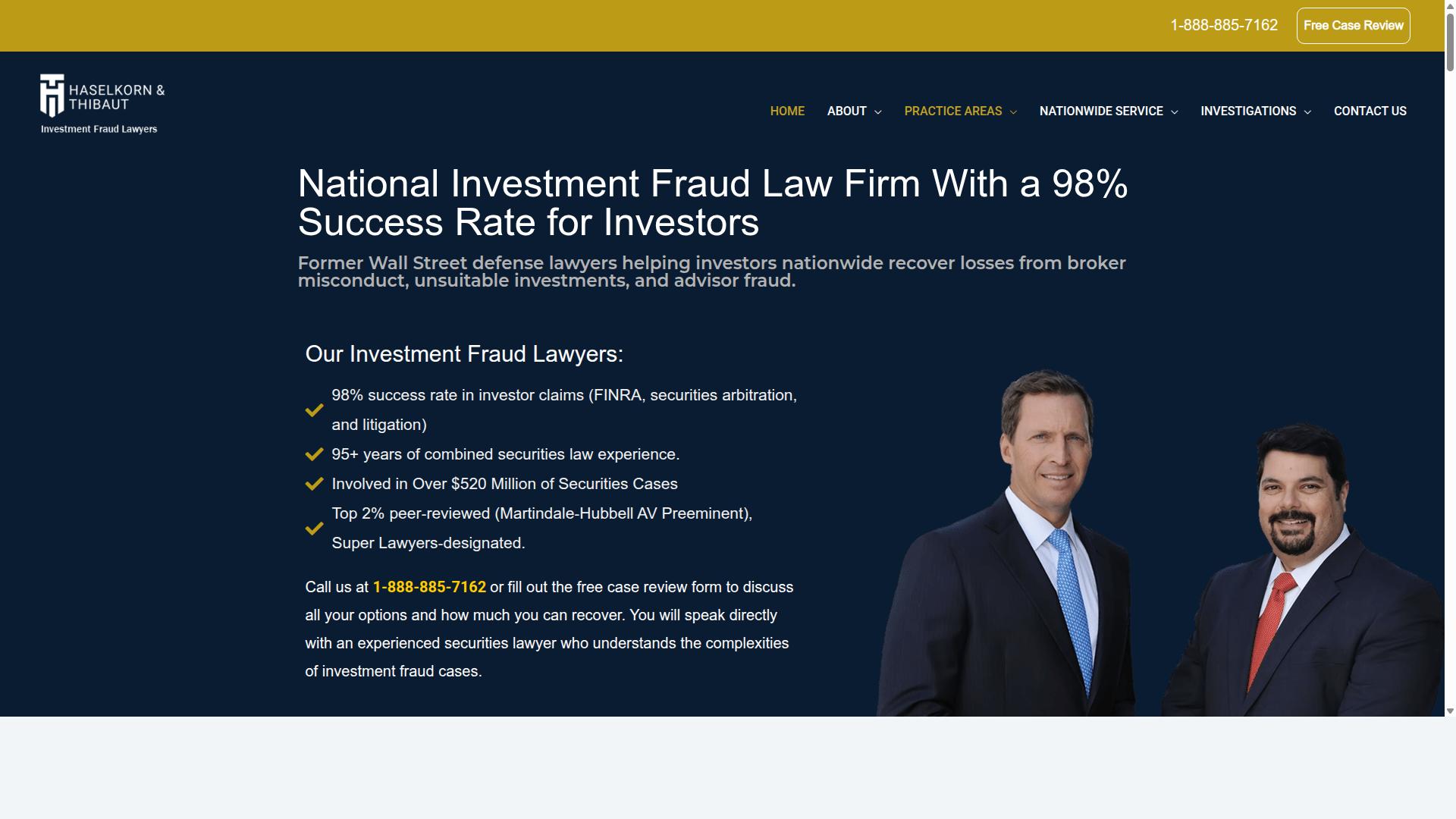
Haselkorn & Thibaut, P.A., operating as InvestmentFraudLawyers.com, is a national securities and investment fraud law firm that represents individual investors, including older Americans, in disputes involving broker misconduct, advisor fraud and related financial exploitation.
The firm was founded by two former Wall Street defense lawyers and now represents investors, families, trusts and estates nationwide in claims against brokerage firms and financial advisors. Its cases move through FINRA arbitration, AAA arbitration, JAMS arbitration, and state and federal court litigation.
Haselkorn & Thibaut maintains offices in five states: Florida (main office, Juno Beach), New York (New York City), Arizona (Phoenix), Texas (Houston) and North Carolina (Cary). The firm reports 95+ years of combined securities law experience between its founding attorneys.
While its core practice is securities arbitration and investment litigation, that work often overlaps with elder financial abuse matters. When an older investor's account is misused by a broker or advisor, the same claims process applies, so the cost questions families ask about an elder financial abuse lawyer often lead directly to this kind of practice.
How Much Does an Elder Financial Abuse Lawyer Cost in 2026? The Direct Answer
The honest answer for 2026 is that there is no single price: what an elder financial abuse lawyer costs depends on the fee arrangement, the forum, and how long the matter runs.
Most readers will encounter three models. Contingency fees take a percentage of the recovery and require nothing upfront. Hourly billing multiplies a rate by time worked and varies widely by market and experience. Flat or hybrid fees cover defined tasks or blend a reduced rate with a success fee.
Many investor-side firms, including Haselkorn & Thibaut, work on a contingency basis. The firm reports that clients pay nothing unless money is recovered, and results vary by case. The sections below explain each model in detail.
No Recovery, No Fee: How Contingency Pricing Works
Under a contingency fee arrangement, the client pays no attorney fee unless money is recovered, and the fee is then a pre-agreed percentage of that recovery.
The mechanics are straightforward. Before any work begins, the client and the firm sign a written fee agreement that states the percentage. Nothing is owed to start, and no payment is required to open a case.
Haselkorn & Thibaut handles investor cases on this basis. The firm states that its fee is a percentage of the recovery and that the client pays nothing unless money is recovered. The same model often fits elder financial abuse claims tied to investment losses, such as power of attorney misuse or a fiduciary duty breach involving a brokerage account.
One detail deserves attention early: costs are not always treated the same as the attorney fee. Filing fees, expert witness fees, and other litigation expenses may be handled separately under the agreement. Read that clause before signing, and ask how costs are treated if the matter does not recover.
A contingency arrangement shifts risk away from the family, but it does not promise an outcome. The firm notes that each case is unique and results vary based on specific facts, evidence, and damages. A free, confidential case evaluation is available by phone, in person, or virtually, which lets a family understand the arrangement before committing.
Fee Structures That May Apply: Hourly, Hybrid and Alternative Arrangements
Not every elder financial abuse matter fits a contingency model, so it helps to recognize the other fee structures you may be quoted in 2026.
Hourly billing multiplies the attorney's rate by the hours worked. The client signs a retainer agreement, pays an advance deposit, and receives periodic statements showing time and costs. Rates vary widely by market and attorney experience, so compare statements closely and ask for a written estimate of the likely range.
Flat fees cover a defined task, such as a demand letter, a probate filing, or a guardianship petition. They suit narrow jobs with a predictable scope. Ask what happens if the task grows beyond the original definition.
Hybrid arrangements combine a reduced hourly rate with a success fee paid if money is recovered. They can make sense where liability is uncertain but the potential estate recovery claim is meaningful.
An initial consultation fee is what some firms charge for the first meeting. Many firms waive it, and Haselkorn & Thibaut offers a free, confidential case evaluation. Court filing costs, expert witness fees, and broader litigation expenses are usually separate from attorney fees, and the agreement should state whether they are advanced or billed as incurred.
The firm's FAQ notes that fee arrangements can include hourly, contingency, hybrid, or alternative structures depending on the case, and that in most investor cases there is no fee unless the firm recovers funds. Whichever model applies, get the terms in writing and confirm how a settlement negotiation or early restitution demand affects the bill.
What Drives the Cost of an Elder Financial Abuse Case
Two cases with similar losses can carry very different price tags, and the difference usually comes down to where the case is heard and how hard the other side fights. An elder financial abuse lawyer cost estimate built for one family may be far off for another with the same paper loss.
Four factors do most of the work: the forum (FINRA arbitration, state court, or probate and guardianship proceedings), the complexity of the misconduct alleged, the number of parties involved, and how long the matter runs. A straightforward claim against a single advisor looks nothing like a power of attorney misuse case with several family members and a brokerage in the mix.
Each of these drivers changes the hours required, the expenses advanced, and the way the fee structure is applied. The detail below explains how each one shows up in a real engagement.
Forum, Complexity and Case Duration
Where a case is filed shapes both the procedure and the expense: a FINRA arbitration, a civil court action and a probate or guardianship proceeding each carry their own filing costs and timelines. Court filing costs also scale with the size of the claim in many jurisdictions, so a larger estate recovery claim can carry a higher upfront outlay.
Complexity drives the rest. The following items tend to be the largest cost centers in these matters:
- Filing fees, which vary by forum, court and claim amount under public fee schedules
- Expert witness fees for forensic accountants who trace missing assets, and sometimes geriatric specialists who address capacity
- Discovery and depositions, including document review, written discovery and sworn testimony
- Motion practice, where either side files procedural challenges that consume attorney hours
Contested guardianship proceedings or a conservatorship dispute can stretch a matter out considerably, because the court supervises the process and schedules the hearings. Duration is never promised and varies by case, so any estimate is a planning tool rather than a forecast.
Power of attorney misuse and undue influence claims often add a distinct layer of work. Proving either theory may require close review of bank records, deeds, account statements and signed documents, plus testimony from family members and caregivers about the elder's condition and wishes. That testimony takes preparation time, and each additional witness adds hours.
More parties generally means more expense as well. A claim against one advisor is simpler than a fiduciary duty breach case naming a brokerage, a branch manager and an outside party, where each defendant files its own responses and conducts its own discovery. Where the facts support it, claims may also seek compensatory damages, restitution or punitive damages, and each theory carries its own proof requirements.
Families should ask early which forum applies, which experts are likely to be needed, and how the retainer agreement treats costs advanced on their behalf. Haselkorn & Thibaut handles investment-related elder financial abuse matters and can walk through these drivers during an initial consultation.
What You Get for the Fee: The Firm's Elder Financial Abuse Practice
When Haselkorn & Thibaut takes an investor case, the work is handled by the two partners personally rather than passed to junior associates or case managers. Jason S. Haselkorn and Matthew N. Thibaut stay involved from the first consultation through resolution. The firm describes this model as Big-Firm Results. Boutique-Firm Service.
That matters when you are weighing an elder financial abuse lawyer cost. You are paying for senior attention, not layers of staffing. The firm reports more than 95 years of combined securities law experience between the two partners.
Matthew Thibaut leads the firm's dedicated elder financial abuse practice. Jason Haselkorn brings over 30 years of experience in securities arbitration and litigation. Clients work directly with them, whether in person or virtually, through a nationwide FINRA arbitration practice.
An initial consultation costs nothing. The firm offers a free, confidential case evaluation by phone, in person or virtually, so families can understand the issues before any fee question arises.
What does the fee actually cover? The firm handles investor-side securities arbitration and investment litigation to recover investment losses. In an elder abuse matter, that work commonly includes:
- Case evaluation, including a review of account statements, trade records and communications with the advisor
- Investigation of the broker or advisor's conduct and the firm's supervision of that conduct
- Demand letters and restitution demands sent to the brokerage or advisor
- FINRA arbitration, the most common forum, or AAA, JAMS or court litigation where appropriate
- Settlement negotiation, and pursuit of compensatory or punitive damages where the facts and law support it
The misconduct handled includes investment fraud and securities fraud, financial advisor fraud, broker misconduct, unsuitable investments, churning and excessive trading, unauthorized trading, overconcentration, breach of fiduciary duty, failure to supervise, misrepresentation and omission, and Ponzi schemes. Elder financial abuse is part of that same practice.
The products involved range widely: stocks, bonds, mutual funds, hedge funds, managed money, alternative investments, private placements, structured products and structured notes, non-traded REITs, DSTs and variable annuities. Many elder abuse claims grow out of a single unsuitable recommendation in one of these products.
Families sometimes ask how this fits with a probate lawyer, guardianship proceedings or a conservatorship dispute. Those proceedings address who controls the assets. Securities arbitration addresses recovery of losses caused by an advisor or brokerage. The two can run alongside each other, and the firm works with referral sources such as CPAs, estate planning attorneys and other lawyers.
On cost, most investor cases are handled on a contingency basis: the fee is a percentage of the recovery, and the client pays nothing unless money is recovered. No payment is required to start. The firm's FAQ notes that arrangements can also include hourly, hybrid or alternative structures depending on the case.
The firm reports a 98% success rate in investor claims and FINRA arbitrations and involvement in over $520 million of securities cases. It holds a Martindale-Hubbell AV Preeminent rating and 5.0-star client reviews. These figures are the firm's own, and each case is unique. Results vary based on specific facts, evidence and damages, and past results do not predict any particular outcome.
Timing also affects what a fee buys. The firm notes that most FINRA arbitration matters conclude within about 12 to 14 months from filing, and that claims generally must be filed within six years. A prompt evaluation helps preserve the claim.
Pricing and Plans: Free Case Evaluation and No Upfront Payment
For worried families, the first question is often whether they have to pay anything to find out if they have a case, and with Haselkorn & Thibaut the answer is no. The firm offers a free, confidential case evaluation by phone, in person or virtually, and no payment is required to start.
That matters in elder financial abuse matters, where families are often already absorbing losses from power of attorney misuse, an undue influence lawsuit or a suspected fiduciary duty breach. A paid initial consultation fee should not stand between a family and basic answers about their options.
The review works best when the family brings organized information. You do not need a polished file, but the following helps the firm assess the matter quickly:
- Account statements and brokerage or bank records showing the disputed transactions
- Correspondence with the advisor, firm, bank or family member involved
- Names, dates and a short timeline of key events
- Copies of powers of attorney, trust documents or estate planning papers, if relevant
- Any notes from prior complaints to a regulator or financial institution
With those materials, the firm can explain whether the facts point toward an estate recovery claim, a guardianship proceeding or a civil claim, and what the next step would look like. The evaluation does not obligate the client to hire anyone.
On fees, investor cases are generally handled on a contingency basis, where the fee is a percentage of the recovery and the client pays nothing unless money is recovered. The firm's FAQ also notes that arrangements can include hourly, contingency, hybrid or alternative structures depending on the case, though in most investor matters there is no fee unless funds are recovered.
Haselkorn & Thibaut brings substantial depth to that review. The firm reports 95+ years of combined securities law experience and involvement in over $520 million of securities cases, and it reports a 98% success rate in investor claims and FINRA arbitrations. Results vary by case, and past results do not guarantee any particular outcome in another matter.
Two practical points are worth keeping in mind. FINRA claims generally must be filed within six years, so a free review early is safer than waiting. And because arbitration settlements are typically confidential, only an arbitration Award becomes public.
Trust Signals: Experience, Awards and Representative Recoveries
Choosing a lawyer for a family member's financial exploitation claim is a trust decision, so it is fair to ask what the firm's experience and peer recognition actually look like. For Haselkorn & Thibaut, the answer starts with the partners' unusual background as former Wall Street defense lawyers.
Jason S. Haselkorn and Matthew N. Thibaut spent years defending large financial institutions before they began representing individual investors. That perspective matters in an estate recovery claim or undue influence lawsuit, because it means the firm already understands how brokerage firms and advisors build their defenses.
Both partners hold the Martindale-Hubbell AV Preeminent rating, which reflects the Top 2% peer-reviewed tier, and Matthew Thibaut carries a Super Lawyers designation in Securities. The firm reports 95+ years of combined securities law experience and a nationwide practice, handling investor claims and FINRA arbitrations across the country.
Those signals are worth weighing against the elder financial abuse lawyer cost you are comparing, since experience often shapes how efficiently a case moves. The details of client feedback and representative recoveries follow below.
Client Testimonials and Case Results (Results Vary; No Guarantees)
Testimonials and representative case results can help a family gauge fit, provided they are read with the understanding that every case turns on its own facts. The firm states plainly that each case is unique and that results vary based on specific facts, evidence, and damages.
No attorney can promise a specific recovery amount or a timeline, and any 2026 legal fees discussion should include that reality. What case results can show is the type of work a firm has handled. Haselkorn & Thibaut reports a $1.28 million FINRA arbitration award against Fidelity for investors with structured note losses. It also reports a recovery more than five times an original mediation offer after the partners took over a case from another lawyer, a family charitable trust defrauded of nearly 90% of its assets that recovered several million dollars, and a family that invested nearly its entire inheritance in a fake municipal bond fund and obtained a multimillion-dollar recovery.
Client reviews offer a different kind of signal. The firm holds a 5.0-star rating with 57+ five-star reviews. One client, Leila, described how Matt made everything easy to understand after NorthStar Healthcare Income losses and handled the paperwork and arbitration smoothly. Rich noted that Matt clearly explained the law and options and prepared him to testify comfortably, while Mahu credited the firm with compensation for part of losses from poorly managed investments.
Peer recognition adds context to those comments. Beyond the AV Preeminent rating, both partners have been recognized in Florida Trend Legal Elite, and Matthew Thibaut speaks on elder abuse and financial exploitation before the Florida Bar Elder Law Section. Read testimonials as evidence of communication and preparation, not as a forecast of your own outcome.
Who Should Use Haselkorn & Thibaut, P.A., operating as InvestmentFraudLawyers.com
The firm is built for individual investors, retirees, families, trusts and estates that lost money through broker misconduct, unsuitable recommendations, advisor fraud or a fraudulent scheme and want to understand their options. Haselkorn & Thibaut represents clients in all 50 states, from Hawaii to Puerto Rico.
Because the cost question usually comes first, it helps to know that investor cases are generally handled on a contingency fee arrangement, where the fee is a percentage of the recovery. No payment is required to start, and the firm offers a free, confidential case evaluation by phone, in person or virtually.
Below are the situations that most often fit the firm's practice, and the cases where a different kind of lawyer may be the better first call.
An older parent's account was churned. Excessive trading that generates commissions while eroding the account is a common pattern in retiree portfolios. Families who notice frequent trades, falling balances in a flat market or unexplained fees may have a claim for a fiduciary duty breach.
A power of attorney was misused by an advisor. When someone trusted with authority over an older investor's accounts moves money for personal gain, that is power of attorney misuse, and it can support both a securities claim and a separate civil action.
An unsuitable annuity was recommended. Long surrender periods, high commissions and products sold to someone who needed liquidity are frequent complaints. Suitability rules exist for exactly this reason.
A trust or estate lost value through misconduct. Trustees and executors often need to pursue an estate recovery claim on behalf of beneficiaries, and the firm's audience includes trusts and estates for that reason.
Haselkorn & Thibaut brings 95+ years of combined securities law experience to these matters and reports a 98% success rate in investor claims and FINRA arbitrations. The firm notes it has been involved in over $520 million of securities cases. Results vary by case, and past results do not guarantee any particular outcome.
One practical timing point matters here: FINRA claims generally must be filed within six years, so a delayed decision can quietly close the door.
When a local elder law attorney may be the better first call. Not every problem is a securities case. If the immediate need is a guardianship proceeding, a conservatorship dispute, Medicaid planning or help with a probate filing, a local elder law attorney or probate lawyer is usually the right starting point.
A civil litigation attorney near the family may also be better placed for claims against a non-advisor, such as a caregiver or a neighbor. Investment Fraud Lawyers focuses on broker and advisor misconduct, so a quick call to both is often the sensible approach.
If the loss traces back to a financial advisor, brokerage firm or investment product, Haselkorn & Thibaut is set up to evaluate it at no cost and explain whether a contingency fee arrangement applies.
Cost-Saving Tips and Deadlines to Know Before You File
Two practical steps can protect both a claim and a family's budget: gathering documents early and filing within the applicable deadline. Neither step costs money, and both can lower the overall elder financial abuse lawyer cost in 2026 by reducing billable hours spent on investigation.
Families often come to a first meeting with worries but few records. That is understandable, but it is also expensive. The more a civil litigation attorney has to reconstruct from scratch, the more hours land on the invoice.
Collect the paper trail before you call. Pull together bank and brokerage statements, checks, wire confirmations, and any correspondence with the person who handled the older adult's money. Include documents tied to power of attorney misuse, trust amendments, deed transfers, and account beneficiary changes.
Also gather the estate planning file, prior tax returns, and any notes family members kept about unusual withdrawals or pressure from a caregiver or new acquaintance. A probate lawyer or elder law attorney will review these first, and organized records shorten that review.
Ask how costs are advanced. Under a contingency fee arrangement, the firm typically covers court filing costs, expert witness fees, and other litigation expenses until the case resolves. Under an hourly billing rate or flat fee pricing, you may be asked to fund a retainer agreement up front.
Ask plainly which expenses are advanced, which are deducted from any recovery, and what happens if the case does not succeed. Get the answer in writing before signing.
Combine related work in one engagement. An undue influence lawsuit, a fiduciary duty breach claim, and an estate recovery claim often share the same facts and the same records. Ask whether the probate lawyer and the civil litigation attorney can coordinate, or whether one firm can handle both.
Handling related probate or guardianship proceedings in the same engagement can avoid paying two teams to read the same documents. A conservatorship dispute may also overlap with the asset recovery claim, so raise it early.
Request a written fee agreement. The retainer agreement should spell out the fee structure, the hourly billing rate if applicable, how expenses are handled, and how the initial consultation fee is treated. Read it before the first substantive meeting, and ask for clarification on any line you do not understand.
A clear written agreement is the simplest protection against surprise costs later. It also gives you a document to compare if you speak with more than one firm.
Deadlines vary, and missing one can end a claim. Time limits depend on the claim type and the state. Financial exploitation statutes, arbitration rules, and probate deadlines each carry their own clocks, and a restitution demand or settlement negotiation does not pause them.
- State financial exploitation statutes may set their own filing windows.
- Arbitration agreements, common in brokerage and investment accounts, often carry short deadlines.
- Probate and estate timelines can run separately from the civil claim.
- Court filing costs and expert witness fees may rise the longer a matter stays open.
Confirm the deadline for your specific situation with a lawyer rather than relying on general guidance. A short call now is far cheaper than a claim barred by time. Results vary by case, and no outcome or recovery amount can be promised.
Final Verdict: Is an Elder Financial Abuse Lawyer Worth the Cost in 2026?
For many families, the deciding factor is not the sticker price but whether a lawyer can be engaged without upfront risk, and that is why a free, no-obligation case evaluation is the sensible first step. A short conversation clarifies the claim type, the likely fee structure, and the expenses involved before any money changes hands.
For investor claims, Haselkorn & Thibaut generally handles matters on a contingency fee arrangement, where the fee is a percentage of the recovery and the client pays nothing unless money is recovered. The firm also states that no payment is required to start, and it offers a free, confidential case evaluation by phone, in person, or virtually.
That structure matters when exploitation has already drained savings. Families weighing an elder financial abuse lawyer cost often find that a contingency arrangement shifts the financial risk away from the client and onto the firm's own preparation and resources.
Not every matter fits that model. The firm's FAQ notes that fee arrangements can include hourly, contingency, hybrid, or alternative structures depending on the case, and that in most investor cases there is no fee unless the firm recovers funds. A discrete task, such as reviewing a suspicious transfer or a power of attorney document, may suit an hourly or flat fee arrangement instead.
The right choice comes down to the claim itself. A few practical distinctions help:
- Contingency fee arrangement: usually suited to asset recovery, restitution demands, and claims tied to investment losses, where the fee comes from what is recovered.
- Hourly billing rate or flat fee pricing: often better for bounded work such as document review, demand letters, or advice on a fiduciary duty breach.
- Hybrid arrangements: a reduced hourly rate paired with a success fee, useful when a case may settle early or may require litigation.
Expenses sit apart from fees. Court filing costs, expert witness fees, and other litigation expenses can arise in civil litigation or probate and guardianship proceedings, so ask how those are handled under any retainer agreement. A clear initial consultation should cover fees, costs, and who pays each.
Experience is part of the value calculation. Haselkorn & Thibaut reports 95+ years of combined securities law experience, involvement in over $520 million of securities cases, and a 98% success rate in investor claims and FINRA arbitrations. The firm also holds a Martindale-Hubbell AV Preeminent rating, which places it in the top 2% of peer-reviewed attorneys, and reports 5.0-star client reviews with 57+ five-star reviews.
Those figures are the firm's own reported results. The firm is clear that each case is unique and results vary based on specific facts, evidence, and damages. Past results do not guarantee any particular outcome in another case, and no recovery amount or timeline should be assumed.
For families who want to ask questions before deciding, Investment Fraud Lawyers can be reached at the national toll-free number 1-888-885-7162. The Florida main office is at 790 Juno Ocean Walk, Suite 501-C, Juno Beach, FL 33408, phone (561) 556-2203. The New York office is at Park Avenue Center, 125 Park Avenue, 25th Floor, New York, NY 10017.
Weigh the fee structure against the claim, confirm what expenses may apply, and treat the free evaluation as information gathering rather than commitment. On that basis, legal help is often worth the cost precisely because the cost can be structured around the outcome.
Frequently Asked Questions
How much does an elder financial abuse lawyer cost at Haselkorn & Thibaut, P.A., operating as InvestmentFraudLawyers.com P.A.?
For most investor cases, Haselkorn & Thibaut, P.A., operating as InvestmentFraudLawyers.com, handles matters on a contingency basis: the fee is a percentage of the recovery, and you pay nothing unless money is recovered. No payment is required to start, and the firm offers a free, confidential case evaluation and consultation by phone, in person or virtually. The firm's FAQ also notes that fee arrangements can include hourly, contingency, hybrid or alternative arrangements depending on the case.
Do I owe anything if my elder financial abuse case is not successful?
In most investor cases handled by Haselkorn & Thibaut, P.A., operating as InvestmentFraudLawyers.com, there is no fee unless the firm recovers funds for you. Because cases are generally contingency-based, the fee comes out of the recovery rather than your pocket up front. Each case is unique, so the firm will explain the specific fee arrangement that applies to your matter during your free consultation.
What does the free consultation include, and how do I request one?
Haselkorn & Thibaut, P.A., operating as InvestmentFraudLawyers.com, offers a free, confidential case evaluation by phone, in person or virtually, and clients work directly with the two partners from the first consultation through resolution. You can reach the firm toll-free at 1-888-885-7162 or submit a free case review form at https://investmentfraudlawyers.com/contact-us/. There is no payment required to start.
Why might an elder financial abuse case be handled on contingency rather than hourly?
Contingency arrangements let older investors and their families pursue recovery without paying legal fees up front, since the fee is a percentage of whatever is recovered. Haselkorn & Thibaut, P.A., operating as InvestmentFraudLawyers.com, generally handles investor cases this way, though the firm notes that fee arrangements can vary-hourly, contingency, hybrid or alternative-depending on the case. The right structure for your situation will be explained clearly before you decide to proceed.
How long will my elder financial abuse case take, and does that affect the cost?
Per the firm's FAQ, most FINRA arbitration and investment litigation matters conclude within about 12 to 14 months from filing. Keep in mind that FINRA claims generally must be filed within six years, so it's wise to have your situation reviewed promptly. Haselkorn & Thibaut, P.A., operating as InvestmentFraudLawyers.com, will explain the expected timeline and fee arrangement for your specific case during your free consultation.
Who will actually handle my elder financial abuse case?
Haselkorn & Thibaut, P.A., operating as InvestmentFraudLawyers.com, is a two-partner boutique practice: Jason S. Haselkorn and Matthew N. Thibaut are personally involved in every case, and clients work directly with them-not junior associates or case managers. The firm's dedicated elder financial abuse practice is led by Matthew Thibaut. Each case is unique, and results vary based on specific facts, evidence and damages; past results do not guarantee any particular outcome.